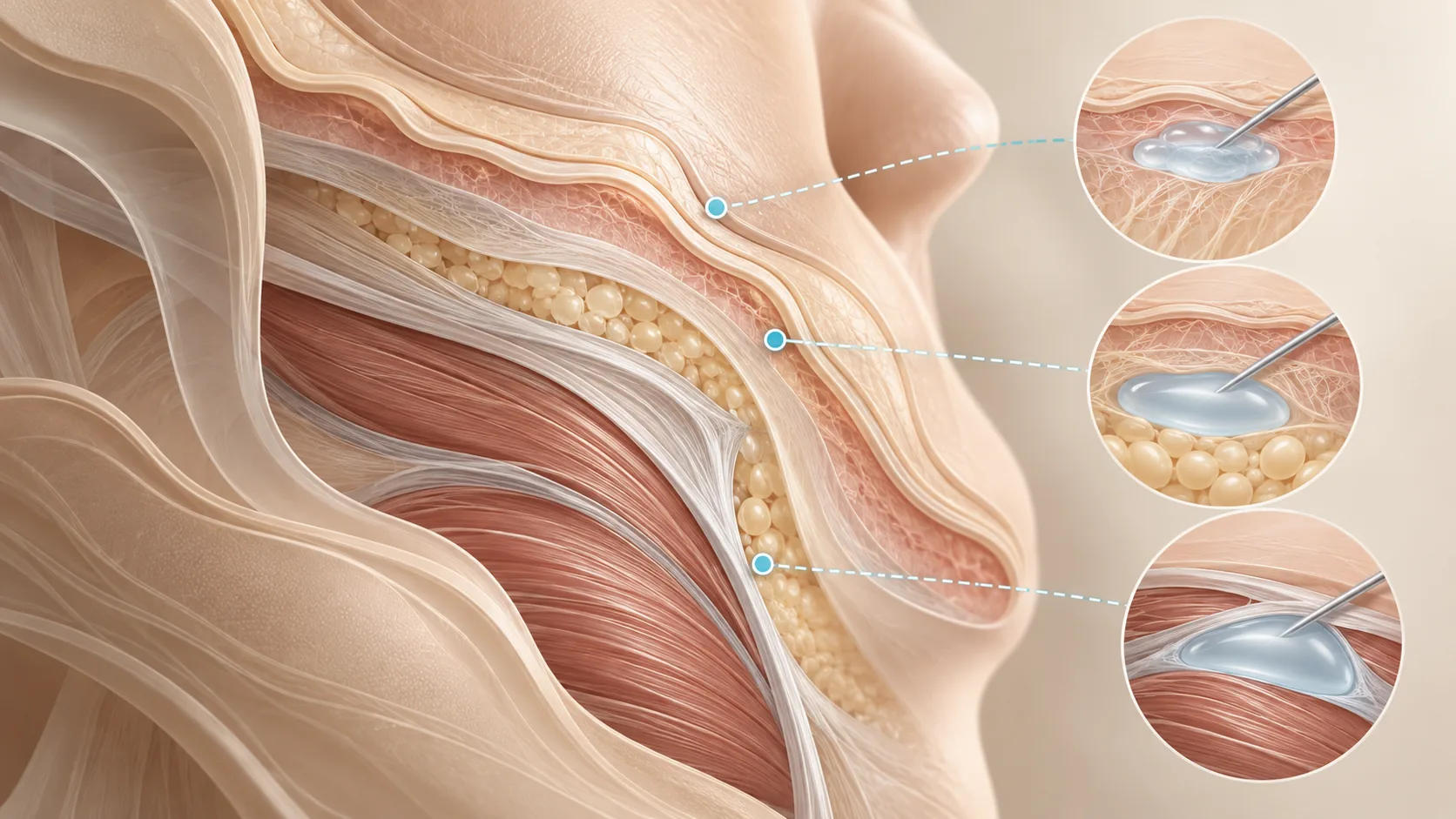
short Description
HA dermal fillers are formulated with different physical and rheological characteristics to address different treatment objectives. Understanding the relationship between anatomy, tissue depth and product characteristics is an important part of treatment planning.
One Filler Does Not Fit Every Application
Facial anatomy is highly variable.
Different regions of the face differ in:
Tissue thickness
Skin characteristics
Fat compartments
Mobility
Mechanical forces
Vascular and anatomical structures
For this reason, filler selection should be based on the characteristics of the treatment area rather than on product viscosity or firmness alone.
Treatment Depth Matters
The depth at which a filler is placed is an important consideration.
Superficial applications may require a gel with characteristics suitable for integration within more superficial tissues.
Deeper applications intended for volume enhancement or contouring may require a formulation capable of providing appropriate structural support.
Matching Product Characteristics to the Treatment Objective
The intended treatment objective can include:
Correction of superficial lines
Correction of moderate wrinkles
Lip contouring
Lip augmentation
Restoration of facial volume
Facial contouring
Different formulations may therefore be designed with different rheological and physical properties.
Clinical Assessment Comes First
Product selection should be based on the individual patient assessment.
Relevant considerations include:
Anatomical area
Tissue depth
Degree of volume loss
Skin and tissue characteristics
Desired correction
Product indication
Injection technique
Patient-specific factors
Key Takeaway
Appropriate filler selection is an individualized clinical decision. Product characteristics should be considered together with anatomy, treatment depth, indication and the intended aesthetic objective.
2 —